

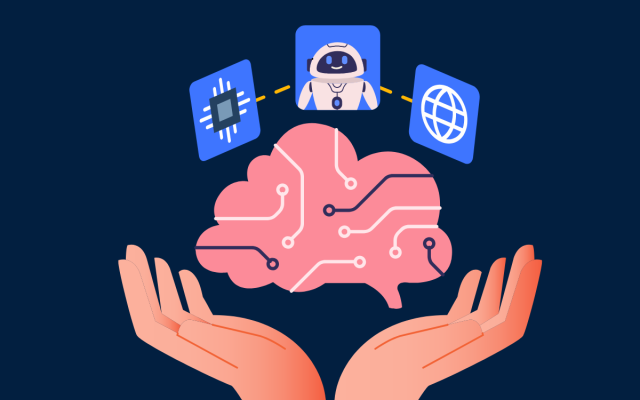
Illustration of a digital brain held in two hands, connected to icons representing a computer chip, an AI robot, and the internet.

Why Study Artificial Intelligence?

Discover how AI is transforming industries, shaping the future, and helping students solve real-world problems.

Students collaborating on an artificial intelligence presentation, demonstrating the hands-on learning experiences that show why an AI degree is worth it.

What Is Artificial Intelligence?

Artificial intelligence (AI) is a branch of computer science that enables computers to perform tasks that typically require human intelligence, including:

  • Learning from data
  • Recognizing patterns
  • Solving problems
  • Making decisions

Understanding AI is just the beginning. An artificial intelligence degree helps you develop the knowledge and skills to shape how these technologies are designed, used, and improved.

Is an AI Degree Worth It?

As artificial intelligence continues to transform industries and everyday life, earning an AI degree can prepare you with the technical knowledge, practical experience, and critical thinking skills needed to navigate an increasingly technology-driven world. Here are a few reasons why an artificial intelligence degree is worth considering.

Prepare for a Technology-Driven Future

Artificial intelligence is reshaping how people work, learn, communicate, and solve problems. An artificial intelligence degree helps you build the knowledge and adaptability needed to keep pace with one of today's fastest-evolving fields.

You'll gain:

  • A strong foundation in emerging technologies
  • Knowledge that evolves alongside AI innovation
  • The confidence to adapt as technology continues to change

Build Skills That Go Beyond AI

An AI degree develops more than technical expertise. Along the way, you'll strengthen transferable skills that are valuable in nearly any field.

You'll develop:

  • Critical thinking and analytical reasoning
  • Creative problem-solving
  • Communication and collaboration
  • Data literacy and informed decision-making

These skills prepare you to tackle complex challenges both inside and outside of technology.

Learn to Innovate Responsibly

The most impactful AI solutions balance technical innovation with human values. That's why studying AI also means understanding its impact on people and society.

You'll explore topics like:

  • Ethics and responsible AI
  • Fairness and transparency
  • Privacy and accessibility
  • Human-centered technology

By combining technical expertise with ethical decision-making, you'll be prepared to build AI that's both innovative and trustworthy.

Apply Knowledge to Real-World Challenges

The best way to learn AI is by putting it into practice. Through projects and hands-on experiences, you'll connect classroom concepts to meaningful applications.

You may:

  • Build AI-powered applications
  • Analyze real-world datasets
  • Design conversational AI assistants
  • Explore machine learning models
  • Solve challenges inspired by real industries

These experiences help transform classroom learning into practical problem-solving skills.

What You'll Learn as an AI Student

📚 Explore Core AI Topics

Build a strong foundation in AI through topics such as:

  • Machine learning & deep learning
  • Natural language processing
  • Computer vision
  • Data analysis & predictive modeling
  • Robotics & intelligent systems
  • AI ethics & responsible technology

🛠 Build Essential Skills

Develop skills that prepare you to think critically and solve complex challenges:

  • Critical thinking & problem-solving
  • Data analysis & evaluation
  • Communication & collaboration
  • Responsible decision-making
  • Ethical AI design
  • Fairness, privacy & transparency

🚀 Learn by Doing

Apply what you learn through hands-on experiences that bring AI to life:

  • Analyze text and uncover patterns
  • Build image recognition models
  • Design conversational AI assistants
  • Explore real-world datasets
  • Complete project-based learning
  • Connect classroom concepts to real applications

Where AI Is Making an Impact

Artificial intelligence is already transforming the way we live, work, and solve problems. From improving healthcare and education to advancing scientific research and enhancing everyday experiences, AI is helping organizations tackle challenges across countless industries. These are just a few of the ways AI is making a difference today.

AI in Everyday Life

Healthcare

Supporting early disease detection, assisting clinicians, and improving access to care.

Education

Personalizing learning experiences and expanding accessibility tools.

Business & Services

Enhancing search, recommendations, and customer experiences.

Entertainment & Media

Helping create, organize, and discover content.

Science & the Environment

Accelerating research, analyzing data, and optimizing resources.

Manufacturing

Optimizing production, improving quality control, predicting equipment maintenance, and creating safer, more efficient operations.

Transportation

Enhancing navigation, optimizing delivery routes, improving traffic management, and supporting the development of autonomous technologies.

Cybersecurity

Detecting threats, identifying unusual activity, and helping organizations respond more quickly to protect people, data, and systems.

Interested in turning these innovations into a career? Discover common AI career paths, salary information, and how an artificial intelligence degree can prepare you for roles across technology, healthcare, robotics, cybersecurity, and more.

Explore AI Careers & Salaries

FAQs About Studying Artificial Intelligence

For students who enjoy technology, creativity, and solving complex problems, artificial intelligence can be an excellent major. AI combines computer science, mathematics, data analysis, and ethics to prepare students to design intelligent systems while considering their impact on people and society. If you're curious about emerging technologies and want to help shape the future, AI may be the right fit for you.

Computer Science provides a broad foundation in software development, programming, algorithms, and computer systems. Artificial Intelligence builds on many of those concepts while focusing specifically on intelligent systems, machine learning, data-driven decision-making, and human-centered technology. Students interested in creating systems that learn, adapt, and solve complex problems may find AI to be the better fit.

No. Many students begin an AI program with little or no programming experience. Foundational courses are designed to teach programming concepts while helping students build confidence in problem-solving, mathematics, and computational thinking. Curiosity, persistence, and a willingness to learn are often more important than prior coding experience.

Mathematics plays an important role in artificial intelligence, particularly topics like algebra, probability, statistics, and calculus. However, studying AI also involves critical thinking, communication, and ethical decision-making. An AI education combines technical knowledge with practical problem-solving and collaboration to prepare students for real-world applications.

student laptop coaching 710x400

Is Studying AI Right for You?

An AI major may be a good fit if you:

  • Enjoy solving puzzles or complex problems
  • Are curious about technology and how it works
  • Like working with data, patterns, or systems
  • Care about how technology affects people
  • Want to build skills in an emerging, fast-changing field
  • Are interested in creativity, innovation, and responsible problem-solving

Ready to Take the Next Step? Explore the AI Major

Still exploring technology majors?

Artificial intelligence is one of many exciting technology pathways. Compare AI with computer science, data science, robotics engineering, and other technology majors to find the program that best matches your interests and career goals.

Find the Right Technology Major

Get in Touch