


Is engineering hard? What to expect and how to thrive

Is Engineering Hard? What to Expect & How to Thrive

Engineering has a reputation for being tough, but what most students don’t realize is how quickly things click once you get the right support, tools, and mindset.

Common Challenges in Engineering

1. Adjusting to College Coursework

The first few semesters can feel like a big leap as you adjust to college-level engineering. You’ll face tougher math, longer labs, and complex problem sets that require more time and persistence.

The key is to stay consistent, ask questions early, and use helpful resources like tutoring, office hours, and study sessions to stay on track. With steady practice, what once felt overwhelming will soon start to feel manageable.

2. Turning Theory into Practice

Engineering isn’t about memorizing—it’s about solving problems and making ideas work in the real world. You’ll take on projects like designing systems, testing materials, or creating prototypes that challenge you to think critically and creatively. 

These tasks rarely have just one correct answer, which means you’ll learn to test assumptions, troubleshoot when things don’t go as planned, and refine your designs through feedback. 

3. Balancing the Workload

Between labs, homework, and exams, time management becomes essential. Engineering courses often build on one another, so falling behind in one class can make future topics more challenging. 

Create a schedule that balances study time and breaks, and tackle big assignments in smaller, manageable steps. Study groups can also help you stay motivated, share ideas, and support each other through tougher weeks.

What Engineering Coursework Looks Like

Understanding the typical progression of classes can help you set expectations and manage engineering major difficulty. Courses generally move from core foundations to hands-on labs and finish with professional design projects. Expand the sections below to learn more: 
 

Your early semesters build a strong foundation in math and science. Depending on the engineering major you choose, you could take courses such as:

  • Calculus I–III, differential equations, and linear algebra
  • Physics with accompanying laboratories
  • Chemistry for engineers
  • Introductory programming (MATLAB, Python, C++, or discipline-specific languages)
  • Engineering design, graphics, or computer-aided design

As you advance, coursework becomes more specialized for your major. Expect classes such as:

  • Statics, dynamics, and mechanics of materials
  • Circuits, electronics, and signal analysis
  • Thermodynamics, heat transfer, and fluid mechanics
  • Materials science and applied chemistry
  • Probability, statistics, and computational methods

Together, these courses develop your ability to connect theory, computation, and real-world problem-solving—the heart of engineering education.

In the lab, you’ll:

  • Design and run experiments
  • Collect, analyze, and interpret data
  • Calibrate instruments and account for uncertainty
  • Communicate results through professional lab reports

In project-based courses, you’ll:

  • Build prototypes or simulations that combine multiple concepts
  • Test, refine, and iterate based on outcomes
  • Incorporate feedback from instructors, peers, or real stakeholders

These experiences strengthen your problem-solving, teamwork, and communication skills—core qualities that prepare you to thrive as an engineer.

Capstone projects are the final stage of your engineering education, where everything you’ve learned comes together.

Across engineering majors, capstone experiences typically include:

  • Working in multidisciplinary teams to address a real engineering challenge
  • Defining client needs and translating them into measurable design requirements
  • Applying advanced analysis, modeling, and experimentation
  • Developing, testing, and refining prototypes or solutions
  • Documenting processes through formal reports, presentations, and design reviews

These courses emphasize:

  • Ethical and professional responsibility
  • Safety, sustainability, and regulatory considerations
  • Project management, budgeting, and scheduling
  • Communication with both technical and nontechnical audiences

Capstone design mirrors real-world engineering work and prepares you for careers in industry, research, government, or graduate study.

Strategies for Thriving in an Engineering Program

Thriving in engineering means more than passing exams—it’s about growth, balance, and connection. At Widener, you’ll find the support and community to turn challenges into success.

Civil Engineering masters professor and student

Using Campus Resources Early

High-performing students know how to use the resources available to them.
Common options include:

Engaging with these tools early helps reinforce your understanding, manage challenges, and stay ahead when engineering coursework becomes demanding.


Widener University business students socialize.

Learning Together

Study groups and peer networks help you approach problems from new angles. Try these strategies to make your sessions more effective:

  • Switch up who leads the problems to keep things fair and help everyone build confidence.
  • Compare how you each solved a problem — you’ll catch mistakes faster and learn new approaches.
  • Explain concepts to each other because teaching something out loud is one of the best ways to actually remember it.
Construction management student at co-op

Connecting Learning to Real Experience

Practical experiences bring classroom learning to life. Consider opportunities such as:

These experiences build your portfolio, strengthen professional judgment, and help you discover which engineering paths excite you most.

Mindsets That Help You Succeed in Engineering

Stay Curious

You don’t need to know everything on day one. Ask questions, explore ideas, and let yourself learn as you go, step by step.

Try, Fix, Repeat

Things won’t always work the first time and that’s normal. Engineering is all about testing and improving along the way.

Learn Together

Studying with others makes everything easier. Sharing ideas, comparing solutions, and helping each other builds confidence fast.

Keep Growing

Hard things get easier with practice. Stick with it, stay open to feedback, and you’ll be surprised by how much you can do.

So...Is Engineering Hard?

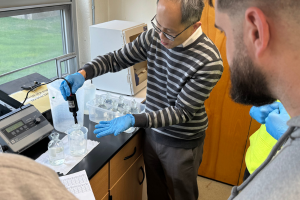
Widener University chemical engineering student working in a lab, showing that while engineering is challenging, it’s also rewarding and achievable.

A Realistic, Encouraging Answer

Engineering challenges you to understand how the world works and use that knowledge to design better solutions. Yes, it can be tough at times, but with the right mindset, tools, and support, you can absolutely succeed. 

At Widener, we’re here for you—with a community of professors, mentors, and resources dedicated to helping you thrive. 

Need help or guidance? Visit mySuccess to access academic and personal support resources, helpful tools, and connections that keep you moving forward.

FAQs

At Widener University, engineering students take a mix of math, science, and engineering-specific courses. Core classes include calculus, physics, chemistry, and computer programming, along with specialized courses in fields like mechanical, civil, electrical, or biomedical engineering.

Widener University offers engineering students support through Tutoring Services, the Math Center, and peer mentoring programs. These resources help students reinforce key concepts in math, science, and engineering courses. Additional academic coaching is also available to improve study skills, exam preparation, and overall academic success. 

View tutoring schedule

Students gain real-world experience through an 8-month paid co-op program while completing their degree on time. Small class sizes allow for close collaboration with faculty, hands-on learning in state-of-the-art labs, and opportunities for research and mentorship. Widener also offers a 4+1 accelerated bachelor’s and master’s pathway, strong career support, and alumni networks to prepare students for successful engineering careers.

Not at all. You really don’t have to walk in being a math or science genius to do well in engineering. What matters more is your willingness to try, ask questions, and keep going even when something feels confusing at first.

Most engineering students have moments where things don’t come naturally. That’s completely normal. What makes the difference is practice and support. At Widener, your professors actually get to know you, and you’ll have access to tutoring, study groups, and hands-on projects that make the tough concepts easier to understand.

Yes, you absolutely can have a life outside of engineering. The workload can be challenging at times, but it’s not nonstop work, and you won’t be studying 24/7.

Most engineering students at Widener are involved in clubs, sports, Greek life, research teams, or part-time jobs. It just takes a bit of planning and figuring out what balance works best for you.

Explore clubs and organizations 

In addition to clubs and organizations, many first-year students choose to join the Engineering Living Learning Community (LLC), which lets you live alongside other engineering majors who understand your schedule and can support you both socially and academically.

So yes, you’ll be busy sometimes, but you’ll also have plenty of opportunities to enjoy campus life and get involved in the things that make college fun and meaningful.

Get in Touch