Widener’s Expanded AI Week Sparks Conversation Across Campus

Building on the success of last year’s AI Day, Widener expanded the 2026 program to a week-long concept in early March, continuing the conversation around AI on campus and across the globe.
Assistant Professor of Philosophy and Chair of the Widener LEAD-AI Council Tom Wilk shared that this year’s expanded event met the needs for additional conversations, as AI has continued to grow rapidly.
“The goal has evolved from just moving the conversation forward. This year’s event really leaned into asking what it will look like to integrate AI into Widener’s curriculum,” said Wilk. “We were really pleased with last year’s event. This year we wanted to be a little more decentralized and expand opportunities for strategically planned smaller events.”
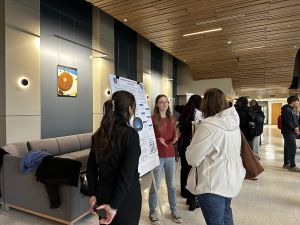
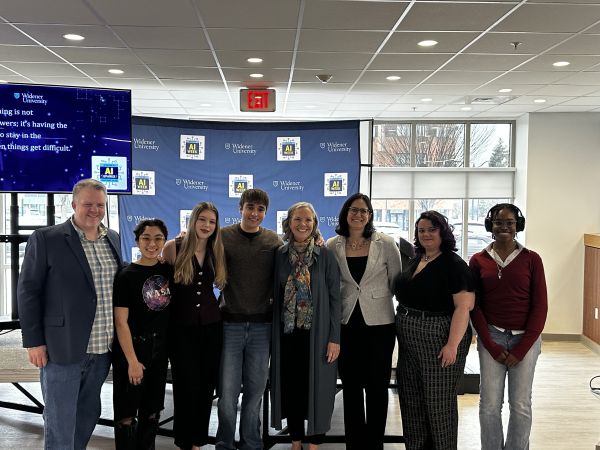
The week’s schedule featured open forums where students could be honest about what they wish faculty knew about AI, student research presentations, learning sessions and the week’s flagship event – AI Sparks. The TED-style event had students, faculty and staff presenting on various topics relating to AI with the goal of furthering the conversation and sparking an idea.
One of the student presenters was Sarah Morishita ’29. A first-year electrical engineering and math double major, and president of Widener’s Math Club, Morishita shared about an experience she had with two different classes and their policies on AI. One class required its use and the other banned it.
“Any time I brought up my two coding classes and their policies on AI to my friends or family, everybody was always surprised by how different they were. I started to think maybe this is a part of something bigger with education and AI. It got me wondering how the story might impact a wider audience. How did my experience add to these conversations about AI? I was experiencing two extremes of the spectrum, and that gave me such a unique perspective I wanted to share,” said Morishita.
Her presentation shared her experience as a student in each of these classes, and how it made her think differently about the role of AI in the classroom and the impact it has on the way students learn, particularly skills and material that is new to them.
“I talked about my experience of going from a complete beginner to really understanding this material and how AI affected this journey,” she said. “Ultimately, my presentation came to the conclusion that even though AI can be used in an impactful way in classroom, it is more important to learn the skill yourself before using AI.”
AI is still a controversial topic for some, but everyone can agree that it is rapidly shaping the world and touching almost every industry. Wilk and the LEAD-AI Council see this as a pivotal moment to ensure students are prepared to enter the workforce of the future.
“What kind of skills do students need? We’re really focused on AI as a critical literacy. Not just being able to use AI, but the deeper skills of ethics and impact. We need to think about where critical AI literacy fits into the curriculum,” said Wilk.
Morishita’s feeling toward AI have softened. While she has reservations around privacy and environmental impact, she also sees practical uses, especially in the education setting. Her best advice is that AI should be used as a tool rather than a shortcut.
“I think one of the most important questions you can ask yourself before using an AI tool is 'How would I have done this pre-AI?' because just a few years ago, none of these tools were available. It's important to remember you are capable of doing these tasks without outsourcing them to a machine,” she said.