Campus Safety

Campus Safety and Emergency Management Office

Campus Safety and Emergency Management protects and supports the Widener community by providing professional 24/7 service, proactive planning, and prevention to foster a culture of safety, trust, and preparedness.

Is Widener University Safe?

Going off to college and spending time away from home can seem intimidating, especially when you don’t know the area. Know that you can put your worries to rest while you’re at Widener University.

Widener University is safe as it can be due to our expert Campus Safety and Emergency Management staff, who work around the clock all year long. You can often find our staff patrolling the grounds in vehicles, on bikes, or on foot. As a department that genuinely cares about the well-being of the University community, you’ll find a state-of-the-art surveillance system that covers the campus and extends into the adjacent surrounding neighborhoods.

Thanks to our staff’s dedicated work, the department has been able to report low crime statistics for the past few years!

About Campus Safety and Emergency Management

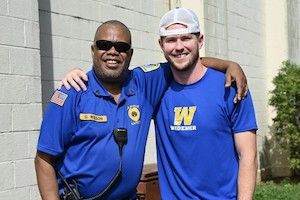
campus safety officer with student 300x200

Campus Safety Officers and Dispatchers

Our highly trained staff patrol the university's campuses 24 hours a day, 7 days a week, 365 days a year. Working closely with local law enforcement, fire, and emergency medical services, our officers are committed to maintaining a safe, welcoming, and supportive environment for all members of the Widener community.

Campus Safety Officers and Dispatchers serve as a resource for students, faculty, staff, and visitors by providing assistance, responding to emergencies, and helping connect individuals with university resources and support services when needed.

Our Campus Safety Officers and Dispatchers:

  • Respond to safety concerns, emergencies, and requests for assistance
  • Monitor and respond to criminal and suspicious activity
  • Conduct routine patrols of campus buildings, grounds, and residence halls
  • Support students and community members during emergencies and critical incidents
  • Coordinate emergency notifications, timely warnings, and crisis response efforts
  • Direct emergency response and evacuation procedures
  • Promote campus safety through education, outreach, and community engagement
  • Supervise fire and life safety programs and response activities
  • Provide escorts, unlocks, and other campus assistance services
  • Serve as a resource and point of contact for students seeking support or guidance
Parking Off-Campus

Chester residents can check their zone eligibility and apply for a residential permit parking permit through the Chester Permit Application Form.

one app. one tap. peace of mind.

Stay Safe with the LiveSafe App

LiveSafe makes it easy to connect with Campus Safety and Emergency Management right from your phone. Need help fast? Just tap to call dispatch. You can even share your location with a friend if you're walking alone. 

The app is free to download—just sign in with your Widener login and you're good to go!

Additional Safety Policies, Procedures, & Resources

The unapproved possession or use of ammunition, chemicals, flammable liquids, items that constitute a fire hazard, fireworks, offensive weapons, or explosives of any kind are strictly forbidden on campus. Offensive weapons include, without limitation, firearms of any kind, guns, pellet guns, B.B. guns, paintball guns, dart guns, bows and arrows, pepper spray and mace, any instrument that can hurl a projectile, brass knuckles, knives, hunting knives, and any other cutting instruments as determined within the sole discretion of the university, except those whose purpose is related to the preparation or consumption of food, as well as ammunition that can cause bodily harm. In addition, items that are not generally considered to be a weapon but could be used or viewed as a weapon are prohibited. Such items will be confiscated immediately.

Students violating these guidelines will be severely sanctioned up to and including expulsion. The university will report such violations to civil authorities if warranted.

Any of the above mentioned implements that are needed for a student’s activities or involvement on or off campus must be registered with Campus Safety and Emergency Management and the Office of Student Engagement and Transformation; control and storage of these items shall be at the discretion of the Executive Director of Campus Safety and Emergency Preparedness.

The university may permit exceptions to this procedure regarding items for the ROTC detachment, in which case control of these items shall be coordinated between the Executive Director of Campus Safety and Emergency Preparedness and the military science professor. All such weapons must be placed in the secured arms area on campus.

Widener University’s Coordinated Community Response Team (CCRT) is a coalition of faculty, staff, and student representatives from across the university. The CCRT works collaboratively to create a culture where consent is centered, survivors are supported, and sexual violence – including domestic violence, dating violence, sexual assault, and stalking - is not tolerated in person or online. In this aim, the CCRT provides inclusive and ongoing education and primary prevention as well as a comprehensive response to reports of sexual violence and misconduct.

Hazing is a serious cultural and public health problem that causes physical and mental harm to students nationwide. In continued support of hazing prevention and awareness, Widener University continues to prohibit all acts of hazing and adheres to the Timothy J. Piazza Antihazing Law, which defines hazing to include Hazing, Aggravated Hazing, and Organizational Hazing.

Learn More About Anti-Hazing

WAVE (Widener Anti-Sexual Education) is a university-wide campus safety program aimed at preventing sexual assault, dating and domestic violence, and stalking. WAVE is led by a coalition of students, faculty, and staff, with a strong emphasis on student input. WAVE provides education on consent, relationships, and bystander intervention.

Read WAVE news story
Access WAVE student resources

During a heightened state of security alert, report any of the following to Campus Safety and Emergency Management:

  • People in buildings or areas who do not appear to be conducting legitimate business.
  • People monitoring areas, buildings, or entrances.
  • Unauthorized people in restricted, sensitive, or private areas.
  • People requesting information with no apparent need for that information.
  • People wearing clothing not consistent with the weather conditions at mass population events (bulky coat in warm weather etc.).
  • Abandoned parcels or other items in unusual locations or high traffic areas.
  • Individuals attempting to access utility locations (water, electrical, petroleum, telecommunications, information systems).
  • Multiple persons who appear to be working in unison, committing the above.
  • Propped open building/residence hall entrance doors/windows.

Also Be Aware Of: 

  • Abandoned vehicles.
  • Vehicles parked near buildings or public and common areas for an extended period of time.
  • Unexpected/unfamiliar delivery trucks.
  • Unfamiliar vehicles parked for long periods of time.
  • Vehicles containing unusual/suspicious parcels or material.
  • Vehicles arriving and being left behind at unusual hours.

In the event of a terrorist attack, natural disaster, or other large-scale emergency, the Department of Homeland Security will provide a coordinated, comprehensive federal response and mount a swift and effective recovery effort.

  • Keep your keys with you at all times; report lost keys to building manager/department head.
  • Protect access codes, combinations, and cards, change codes regularly; report compromised codes to the person in charge.
  • Familiarize yourself with building exits and emergency exit routes.
  • Report suspicious tampering with physical security (doors, locks, etc.).
  • Talk with co-workers; know what is out-of-place (unclaimed or unfamiliar items, etc.).
  • Account for and secure all sensitive material/information when you are not able to attend to it.
  • Account for and secure sensitive deliveries in a timely manner.
  • Homeland Security
    PA 717-651-2715
    DE 302-744-4101
    DE 302-659-3362 DEMA
  • State Police
    PA 484-840-1000 Chester
    PA 717-671-7500 Harrisburg
    DE 302-761-6677
  • Water Company
    PA 610-876-8181 Chester
    PA 717-238-8725 Harrisburg
    DE 302-366-7055
  • Electric/Gas Company
    PA 800-841-4141 Chester
    PA 800-841-4141 Harrisburg
    DE 302-366-7050
  • Mayor's Office
    PA 610-477-7723 Chester
    PA 717-255-3040 Harrisburg
    DE 302-571-4100 Wilmington
Weather Ready Ambassador Logo

As a WRN Ambassador, Widener University commits to working with NOAA and other Ambassadors to strengthen national resilience against extreme weather. In effect, the WRN Ambassador initiative helps unify the efforts across government, non-profits, academia, and private industry toward making the nation more ready, responsive, and resilient against extreme environmental hazards.

This is the first step to become a StormReady® Community.

For more information visit the Weather-Ready Nation website.

All property found on campus should be taken to the Campus Safety and Emergency Management, located in Old Main, within 48 hours of when it was found. Campus Safety and Emergency Management will serve as the custodian of all found property. If an individual finds an object in public areas, it is his or her responsibility to take it to Campus Safety and Emergency Management. Items left in common areas such as the library and dining hall will be taken to Campus Safety and Emergency Management by the staff workers in these areas. All staff workers will be directed to take found items to Campus Safety and Emergency Management no later than the end of their shift. Athletic clothing and other athletic-related items found at the Schwartz Center will be handled by the equipment room at Schwartz Center.

Please use discretion in dealing with lost property. For example, a textbook that contains owner identification found in a classroom should, if possible, be given to the student rather than transferring it to Campus Safety and Emergency Management.

Campus Safety and Emergency Management will store and catalog all found items. It will maintain a database of all these items and provide the documentation necessary to ensure that these items are returned to the appropriate owners or finders. Upon receipt of an object, Campus Safety and Emergency Management will attempt to identify and contact the owner. If the owner cannot be identified, Campus Safety and Emergency Management will proceed as follows:

  • Attach an ID label to the item noting where, when, and by whom it was found.
  • Give the finder a receipt for the found object. The receipt will contain the ID number of the finder, a description of the object, and where and when the object was found.
  • Enter the item in a database.


Procedure for claiming lost items:

  • Try to locate lost items in Campus Safety and Emergency Management as soon as possible. Any such inquiry will be logged by Campus Safety and Emergency Management.
  • Prior to being shown any item, the claimer must describe the item and indicate the approximate time and place where the item was lost.
  • The claimer will sign a form confirming that the item claimed is their property.


Procedure for the disposal of found property not claimed:

  • Campus Safety and Emergency Management will hold the found property for 30 days. During that time, owners of the lost property will be able to claim the items they lost.
  • After 30 days, Campus Safety and Emergency Management will attempt to contact the finder and offer her or him the items found. However, the Executive Director of Campus Safety and Emergency Preparedness may recommend that an item be retained for a period of longer than 30 days before it is offered to the finder.
  • If the finder does not claim the property within 10 days after notification, the Executive Director of Campus Safety and Emergency Preparedness will appropriately dispose of the property.

Looking for Ways to Be Smart About Safety?

The Personal Safety page gives you practical tips, reporting options, and campus resources to help you feel secure and supported every day at Widener.

Get in Touch